CHEM V101 Lecture Demonstration
Limiting Reactant Visualization
Overview
This short in-class demonstration was used to visualize the concept of limiting reactants during the Stoichiometry and Gas Laws lecture. Students often find the limiting reagent abstract when discussed purely as a calculation problem; this visual setup allowed them to observe how gas production stops once one reactant is consumed, even when the other remains in excess.
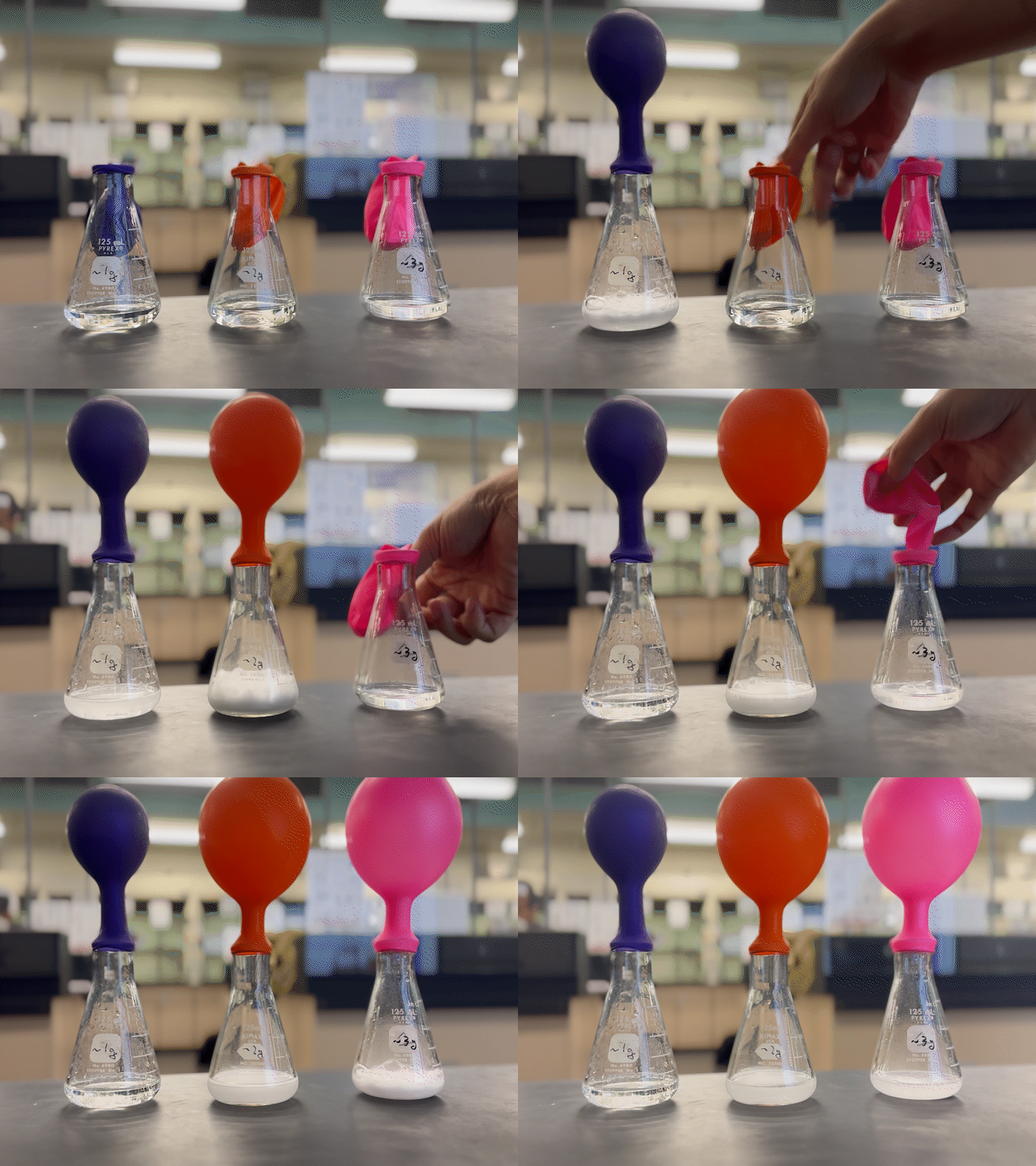
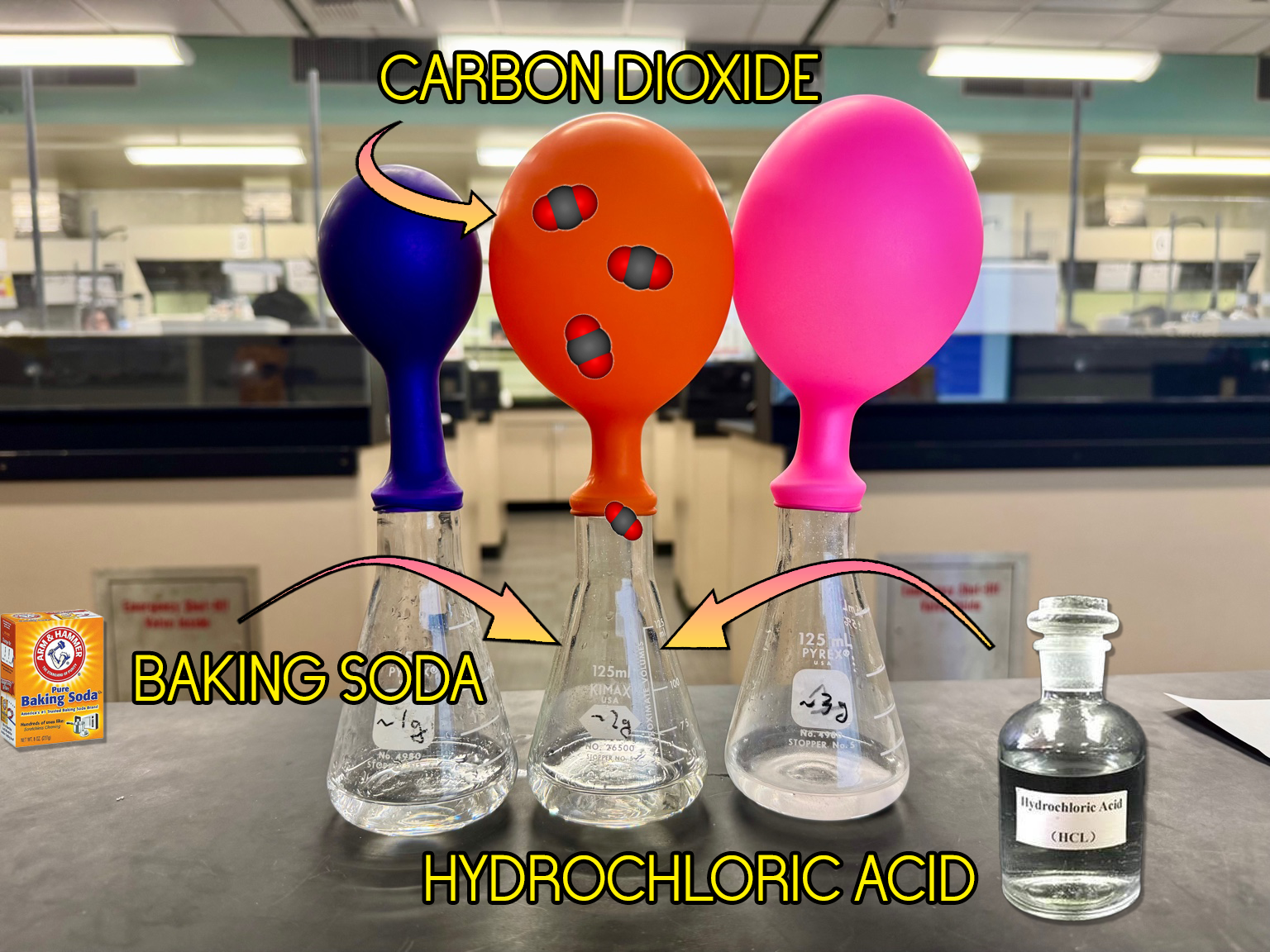
Three 125 mL Erlenmeyer flasks were prepared with equal amounts of 1 M HCl (20 mL each) and varying masses of NaHCO₃ (1 g, 2 g, and 3 g). Balloons were fitted on top of each flask to collect the CO₂ gas produced. The visibly different balloon sizes served as a clear indicator of the reaction yield controlled by the limiting reagent.
Pedagogical Purpose
While the reaction proceeded, students predicted which reactant would limit CO₂ formation, performed mole-ratio calculations, and compared their theoretical results with the observed balloon volumes. The demonstration reinforced three key ideas:
-
The limiting reactant determines the theoretical yield.
-
Adding excess of the other reactant does not increase product formation once the limit is reached.
-
Stoichiometric reasoning can be directly connected to visual and quantitative data.
Demonstration Process and Concept
Each flask contained 20 mL of 1 M HCl solution, while the baking soda (NaHCO₃) was measured and placed inside the balloon before attaching it to the flask. When the balloon was lifted, the powder fell into the acid, immediately generating bubbles of CO₂ gas that inflated the balloon.
In the first two samples, increasing the mass of NaHCO₃ caused visibly larger balloons—students could see that more reactant produced more gas. However, by the third flask (~3 g NaHCO₃), the balloon no longer expanded further. Despite having more solid present, the reaction stopped once all available HCl had been consumed, showing that the acid became the limiting reactant.
This clear visual turning point helped students connect the idea of the limiting reagent to a real observable effect: after a certain threshold, adding excess of one substance no longer increases product yield because the other reactant is completely used up.
Reaction and Stoichiometric Setup
+
HCl
→
NaCl
+
H2O
+
CO2
| Sample | NaHCO3 (g) | mol NaHCO3 | mol HCl | Limiting Reagent | mol CO2 | Volume CO2 @ STP (22.4 L mol−1) |
|---|---|---|---|---|---|---|
| #1 | 1.00 | 0.0119 | 0.020 | NaHCO3 | 0.0119 | 0.0119 × 22.4 = 0.267 L (267 mL) |
| #2 | 2.00 | 0.0238 | 0.020 | HCl | 0.0200 | 0.0200 × 22.4 = 0.448 L (448 mL) |
| #3 | 3.00 | 0.0357 | 0.020 | HCl | 0.0200 | 0.0200 × 22.4 = 0.448 L (448 mL) |